
Smarter Energy Management™
Your home already has the power. It just needs a brain.
Solar, battery, generator, and grid power usually operate separately. The Koolbridge SMART LOAD CENTER™ replaces your traditional panel with one that monitors every circuit — and decides, circuit by circuit, which power source serves it. Not just what turns on. Where the power comes from.
- UL Listed
- Patent-protected dual-bus design
- 10-year limited warranty
- Designed, engineered, and assembled in the USA
Your electrical panel was built to distribute power, not manage it.
Today’s homes are adding solar, batteries, EV chargers, generators, heat pumps, and other high-demand appliances. But most electrical panels still treat power the same way they did fifty years ago — one source in, everything else downstream.
Solar power gets sent to the grid when it could be doing work at home.
Battery backup gets drained by loads that didn’t need to run.
EV charging, HVAC, and appliances compete for limited capacity.
The SMART LOAD CENTER™ adds intelligence where it matters most: between your energy sources and the circuits in your home.
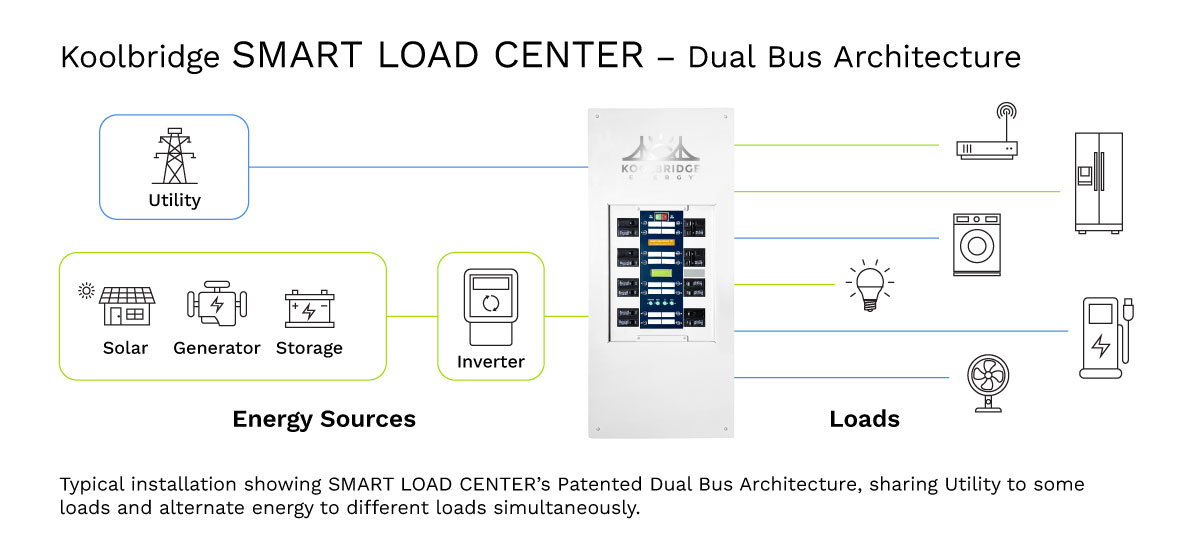
Other smart panels decide what to turn off. This one decides where your power comes from.
Every smart panel on the market can monitor circuits and shed loads. The SMART LOAD CENTER™ does something no other panel does: it runs two power paths — the grid and your solar, battery, or generator — side by side, and assigns each circuit to the right source, automatically.
Your refrigerator can run on solar while your dryer runs on grid power. When rates spike, flexible circuits can move to your battery. When the grid goes down, the circuits you chose in advance are already on backup power — no transfer switch, no whole-home gamble, no rewiring.
It’s called dual-bus architecture, and Koolbridge holds the patents on it. The 2026 National Electrical Code now formally recognizes this distinction — between systems that only manage loads and systems that control power sources. The SMART LOAD CENTER™ was built as the second kind from day one.
One panel. Two power paths. Every circuit assigned to the source that makes sense right now.
One panel. Built for the way you actually use energy.

Put your solar to work at home.
Instead of automatically exporting excess solar, the SMART LOAD CENTER™ can route it to circuits that can use it now — water heating, EV charging, flexible loads — so more of what you produce does work in your own home.

Make backup power last.
When backup power is limited, the SMART LOAD CENTER™ keeps the circuits you prioritized on your battery or generator while lower-priority loads wait. A smaller battery, managed well, can outlast a bigger one that powers everything at once.

See and control every circuit.
The SMART LOAD CENTER™ monitors and controls each circuit individually. Set your priorities once — before the storm, before the trip, before rates change — and the panel carries them out.

Is it right for your home? A quick way to tell.
It may be a good fit if you are:
- Installing a new solar system
- Adding battery backup
- Connecting a backup generator
- Planning for EV charging or more electric appliances
- Upgrading an outdated electrical panel
- Building a new home
- Preparing for time-of-use electric rates
- Looking for better outage protection
- Trying to understand where your home uses the most energy
The best next step is to talk with Koolbridge or a qualified installer about your home, your current electrical system, and your energy goals.
Choose your system type
Capture more value from the power you already produce.
Solar panels often produce the most when your home is using the least. The SMART LOAD CENTER™ coordinates selected circuits with available solar production, utility rates, and your preferences — routing power to loads that can use it instead of defaulting to export.
MINI-METRICS: Home-first solar — route production to circuits that can use it | Rate timing — shift flexible loads to lower-cost hours
WITHOUT SMART LOAD CONTROL: Solar, appliances, and utility pricing each operate on their own.
WITH THE SMART LOAD CENTER™: Selected loads run when solar is available or when rates make more sense.
Make a finite battery last where it matters most.
A battery can only do so much if every load in the home is treated the same. The SMART LOAD CENTER™ assigns your essential circuits to backup power and holds lower-priority loads back — so the battery you have goes further during an outage.
MINI-METRICS: Backup runtime — focus the battery on essential circuits | Battery value — coordinate rates, solar, and loads
WITHOUT SMART LOAD CONTROL: Your battery may be forced to power everything at once.
WITH THE SMART LOAD CENTER™: Critical circuits stay protected while lower-priority loads wait.
Automate the decisions you used to make manually.
Off-grid living means balancing solar production, battery state, generator runtime, weather, and daily usage. The SMART LOAD CENTER™ manages those decisions using preset rules, circuit priorities, and system modes.
MINI-METRICS: Generator runtime — run only when rules require it | Battery reserve — protect critical loads first
WITHOUT SMART LOAD CONTROL: You are watching battery levels and manually shedding loads.
WITH THE SMART LOAD CENTER™: Settings and thresholds take over the guesswork.
Support modern electric living more intelligently.
EV chargers, heat pumps, induction ranges, and other large loads increase demand on your home’s electrical system. The SMART LOAD CENTER™ coordinates high-demand circuits so they work within your service capacity — and in some installations, smart load management may help avoid or defer a costly service upgrade, depending on your home, equipment, code requirements, and installation design.
MINI-METRICS: Load coordination — manage high-demand circuits together | Service upgrade planning — may help avoid or defer an upgrade
Homeowner wins
SOLAR VALUE — Put your solar to work at home
Route production to flexible loads that can use it now, instead of automatically sending excess to the grid.
ELECTRIFICATION — Add EV charging with smarter load management
Coordinate high-demand loads and, in some installations, help avoid or defer a costly service upgrade.
RESILIENCE — Prepare before the outage starts
Set priorities for critical circuits before bad weather, travel, or backup-power needs become urgent.
VISIBILITY — See what is using energy
Per-circuit data reveals always-on loads, peak-time habits, and usage patterns whole-home totals hide.
BATTERY PROTECTION — Use stored power where it matters most
Assign batteries to priority circuits instead of letting them drain on loads that can wait.
COMFORT — Automate decisions without changing your routine
Set your preferences once, then let the panel manage selected circuits based on your priorities.
What changes when the load center becomes intelligent?
A traditional system distributes or stores power. The SMART LOAD CENTER™ decides how — and from which source — that power is used.
| Capability | Traditional grid-tied solar | Traditional solar + battery | With Koolbridge SLC™ | Traditional off-grid system |
|---|---|---|---|---|
| Circuit-by-circuit power source selection | No — one source path | No — whole-home or subpanel transfer only | Manual switching | Yes — each circuit assigned to grid or alternate source, automatically (patent-protected) |
| Circuit-level energy visibility | No or limited | Usually whole-system only | Limited | Yes, by individual circuit |
| Circuit-level control | No | Limited or subpanel-based | Manual or inverter-limited | Yes, by individual circuit |
| Solar-aware load management | No | Limited | Manual | Yes, based on settings and conditions |
| Battery runtime support | N/A | Basic backup settings | Manual thresholds | Yes, when paired with compatible system design |
| Time-of-use load shifting | Manual scheduling | Basic inverter scheduling | N/A | Yes, based on settings and installation |
| Outage preparation modes | No | Manual reserve settings | Manual checklist | Yes, configurable modes |
| EV charging and larger electric loads | May require upgrades | Capacity-constrained | Complex load planning | Built to support smarter load management |
Savings, backup runtime, service upgrade avoidance, and battery performance vary by home, equipment, usage patterns, rates, weather, and installation design. The SMART LOAD CENTER™ is not intended for use in emergency systems or legally required standby systems (NEC 700/701). All electrical work should be evaluated and performed by qualified professionals in accordance with local code.
Available models
Choose the right configuration for your home.

SMART LOAD CENTER™ 125A
A strong fit for many residential projects where homeowners want smarter control for solar, battery, generator, or future electrification needs. 125A capacity, 16 breaker spaces.

SMART LOAD CENTER™ 200A
Designed for larger homes, higher-demand systems, or projects where added capacity and flexibility matter. 200A capacity, 32 breaker spaces.
Shared Features
- Patent-protected dual-bus architecture
- Circuit-level monitoring and control
- 100% passive cooling
- 10-year limited product warranty
- Designed, engineered, and assembled in the USA
- Compatible with standard Eaton BR, Square D Homeline, and GE Q breakers
Your installer can help determine which configuration fits your home, electrical service, and energy goals.
For the technically curious
How circuit-level source control works
The SMART LOAD CENTER™ manages power at the circuit level, not just the whole-home level. Its dual-bus design carries utility power and alternate-source power side by side; each circuit is monitored and assigned to the appropriate bus based on system conditions and your settings.
What the system coordinates
- Solar production
- Battery state of charge
- Generator availability
- Grid power
- Time-of-use rate periods
- Critical and noncritical loads
- High-demand circuits such as EV charging, HVAC, water heating, and major appliances
Questions to ask your installer
- Which circuits in my home should be considered critical?
- Can this help extend battery backup during an outage?
- Can this help manage EV charging or other high-demand loads?
- Could smart load management help avoid or defer a service upgrade?
- How would this work with my solar inverter, battery, or generator?
- What settings would I use for daily life, travel, and outage preparation?
Make your home's energy system work as one.
Your home’s energy system should do more than produce, store, and distribute power. It should put every circuit on the right source at the right time. Whether you are installing solar, adding battery backup, preparing for EV charging, or planning for future electrification, Koolbridge can help your home get there with confidence.
